
XRP confidential transfers: what XLS-96 hides, for whom
By zerps. Published .
XRP confidential transfers are a change the XRP Ledger is voting on, from the standard XLS-96. They hide the amount of a token payment and the balances behind it. Sender and receiver stay public, and the token's issuer can still read every amount. XRP itself stays public. On 27 November 2026 it had 22 of the 35 validators and needs 29. There is nothing you have to do.
Every payment on the XRP Ledger is public today. Anyone can look up who paid, who got paid, and how much. That openness is why people trust the ledger. It is also why a bank cannot run its payments on it.
A change now in the vote fixes exactly that. It is called confidential transfers, or private transfers, and it hides one thing: the amount.
This article shows what it hides and what it leaves in the open, with three examples from real life, how the ledger checks a payment it cannot read, what it does for XRP, and where the vote stands. The vote was read on 27 November 2026.
- 22 of 35 validatorsbacked the ConfidentialTransfer amendment on 27 November 2026. It needs 29, held for two weeks.
- The amount is hiddenBalances and transfer amounts are sealed. Sender, receiver and the token stay public.
- Tokens, not XRPIt covers Multi-Purpose Tokens whose issuer switches it on. XRP payments stay public.
- A key for the auditorThe issuer can read every amount, and can name one auditor who can too.
- Ten times the feeA confidential transfer pays 100 drops of XRP where a normal one pays 10, and that XRP is destroyed.
- 6 August 2026The day the code shipped, in version 3.3.0 of the ledger's software.
What are XRP confidential transfers?
XRP confidential transfers are token payments on the XRP Ledger whose amount is hidden. Everyone can still see that a payment happened, and between whom. Nobody outside can see how much. The public standard is XLS-96.
The names can confuse, so here they are once. The standard is XLS-96, "Confidential Transfers for Multi-Purpose Tokens", often shortened to confidential MPTs. The amendment the validators vote on is called ConfidentialTransfer. The ledger's own release notes say "private transfers", and people also look for it as XRP private transactions or XRP privacy. All of these mean this one feature.
The reason it was built is in the standard's own words: today "all balances and transfers remain publicly visible", and that "limits adoption in institutional and privacy-sensitive contexts".
What do confidential transfers hide, and what stays public?
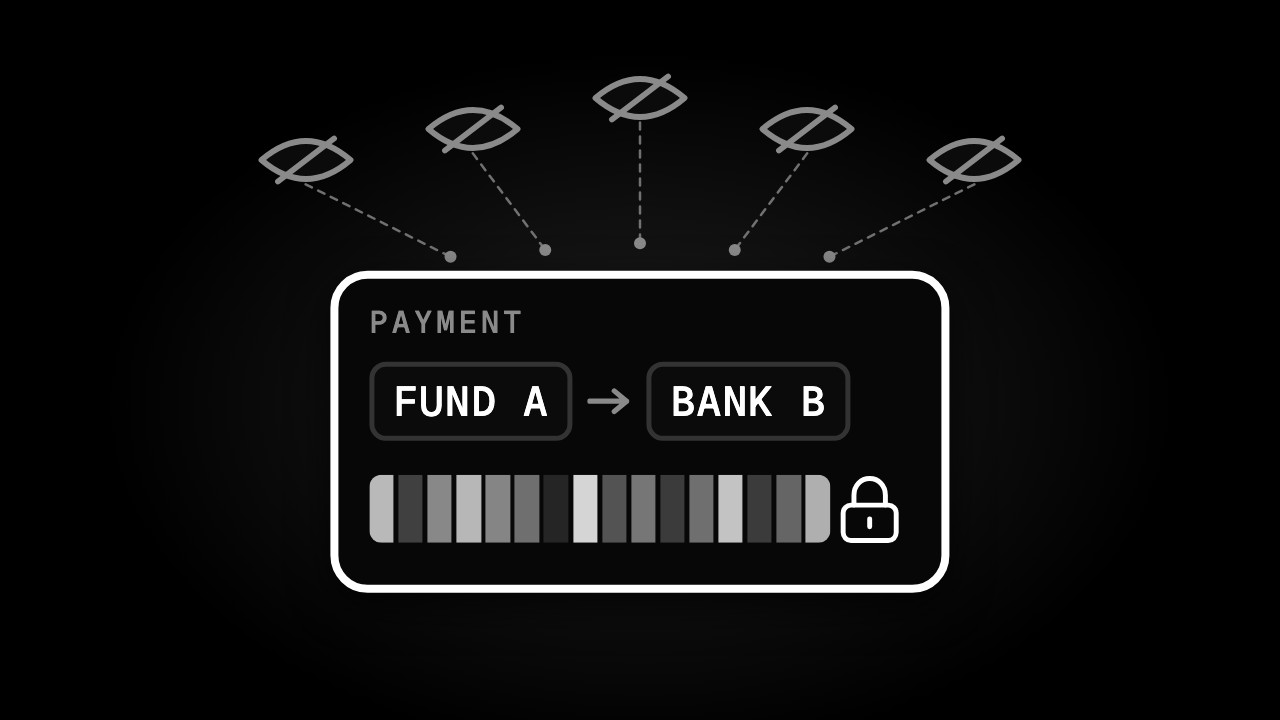
Confidential transfers hide two things: how much was sent, and how much an account holds. Everything else stays public: who sent it, who received it, which token it was, and when.
| Hidden from the public | Still public |
|---|---|
| The amount of each transfer. | The sender and the receiver. |
| The balance of each holder. | Which token moved, and when. |
| How a token is spread over its holders. | The total supply of the token. |
| The amount when tokens go into private form, or come back out. |
The ledger's documentation lists the same. RippleX, the team at Ripple that works on the ledger, puts it in one sentence: "Observers see that a transfer occurred but cannot read the amount."
An example: a payday, an invoice and a fund
Three everyday cases show why the amount matters more than the names. The first two are ours and their figures are invented. The third is Ripple's own.
- A payday. A company pays four people in a token: 4,200, 6,900, 3,100 and 9,800. On a public ledger every colleague can look up what the others earn. With confidential transfers they see that payday happened. They do not see who earns what.
- An invoice. A shop pays its supplier 1,850 for a hundred pieces, then 3,700 for two hundred. A rival who reads both payments knows the shop pays 18.50 a piece. With confidential transfers the rival sees a payment, and not the price.
- A fund. In Ripple's example it is Sunday evening, news breaks, and a fund holding 50 million dollars in tokenized assets wants to put them to work before the market opens. On a public ledger every trading desk in the world could watch that move.
That last one is why institutions ask for this. The same post lists what a regulated institution needs before it can move a tokenized asset at all. One of the five points: "keep its trading strategy off a public feed".
How does the XRP Ledger check a transfer it cannot read?
The ledger checks a proof. Each confidential transfer carries math that shows the payment is valid without showing the amount. The validators check the math. They never open the number.
The documentation names what the proof shows:
- The sender had enough. Nobody can send more than they hold.
- The amount is not negative. So no money can be made up.
- Every copy says the same. The sender's, the receiver's, the issuer's and the auditor's copy of the amount all hold one number.
In its words, validators "can only check the mathematical correctness of these proofs", and "cannot see the actual amounts involved". The technique is called a zero-knowledge proof, ZKP for short. The amounts themselves are locked with an encryption scheme named EC-ElGamal.
And a transfer with a bad proof goes nowhere. The standard says it is rejected, "functioning identically to an invalid signature". The total supply of a token stays in the open the whole time, so anyone can still check that no token appeared from nothing.
Who can still read a confidential transfer?
Three parties can read a confidential amount: the holder, the token's issuer, and one auditor if the issuer names one. For everyone else the amount is sealed.
That is by design. Each balance is stored encrypted more than once: for the holder, for the issuer, and for the auditor. The documentation says balances are "only visible to the holder, issuer, and any configured auditors". A holder cannot show one number to the auditor and another to the issuer, because the proof ties all copies to one value.
So this is privacy from the public, with a door for the regulator. The standard calls that selective disclosure: privacy for the holder, and compliance for the people who have to check. One of the standard's authors, Ayo Akinyele of Ripple, put the case like this: "Without privacy, financial institutions cannot safely use public ledgers for core workflows. Without accountability, regulators cannot sign off. With programmable privacy, we can have both."
The issuer also keeps its other powers. It can still freeze a holder, and it can still take tokens back.
Is XRP itself private with confidential transfers?
No. XRP payments and XRP balances stay exactly as public as they are today. Confidential transfers cover one kind of token on the ledger, the Multi-Purpose Token, and only when its issuer switches the feature on.
The standard's first author was asked about XRP in the public discussion. The answer: "This proposal implements confidential transfers for MPTs only."
Two more steps stand between a token and a private payment. The issuer has to enable it for that token, and that choice cannot be undone. And each holder has to opt in by moving tokens into private form. Tokens on trust lines, the older kind, are not covered.
That split fits how the ledger is used. XRP is the open, neutral asset everything else is paid in. The tokens that ride on it, such as tokenized funds, stablecoins and other real-world assets, are the ones whose holders need their amounts kept quiet. Our piece on why RLUSD needs XRP shows the same division of work.
What do confidential transfers cost in XRP?
A confidential transfer costs ten times the normal fee, paid in XRP. The ledger's table of transaction costs lists 100 drops for one, against the usual 10. Like every fee on the ledger, that XRP is destroyed.
The reason is work. Checking a proof costs the validators far more than checking a plain payment, and the fee prices that in. 100 drops is 0.0001 XRP, so it stays cheap for the sender.
For XRP it means every private payment of any token burns ten times what a public one does. The ledger's own total showed 14,466,535 XRP destroyed on 27 November 2026.
What confidential transfers cannot do: the limits and the risks
Confidential transfers are a first version, and the standard is open about what they leave out. They work for direct payments only, they do not hide who pays whom, and a lost key means lost money.
- Direct payments only. They do not work on the ledger's exchange, in escrows or in checks.
- Going in and out is public. The amount is visible when tokens move into private form and when they come back. With few users, sums can be worked out.
- A lost key is lost money. The documentation: "If a holder loses their private key, their confidential funds are permanently lost."
- The issuer keeps its power. It reads every balance, can freeze, and can take a holder's tokens back.
- One auditor, named at the start. An auditor cannot be added to a token later.
- Not safe against quantum computers. The standard says so itself. Our piece on quantum-resistant keys for XRP covers that road.
The code was reviewed from outside before it shipped. Trail of Bits examined it for six weeks in April 2026 and listed 17 issues. Ripple's test report of September 2026 says no critical bug is open.
Are XRP confidential transfers live? Where the vote stands
No. On 27 November 2026 the amendment had 22 of the 35 validators. A change switches on only after more than 80% have backed it for two weeks without a break. With 35 validators that means 29.
| Amendment | What it adds | Votes on 27 November 2026 |
|---|---|---|
| ConfidentialTransfer | Private amounts and balances for tokens (XLS-96). | 22 of 35 |
| DynamicMPT | Lets the issuer of an existing token change its settings, and so switch privacy on. | 18 of 35 |
The code is finished. It shipped on 6 August 2026 in version 3.3.0 of the ledger's software, and on the developers' test network it is already switched on. On the main ledger it waits for seven more validators. You can follow the count on XRPScan.
Votes can move fast. The vault amendment stood at 23 on 14 November and had its majority eleven days later. And Ripple says of this release: "Multiple financial institutions are lined up behind this release like Aviva and Licuido."
What should XRP holders do about confidential transfers?
Nothing. There is no setting to change, no key to make and no deadline. Your XRP works exactly as before, and your XRP payments stay public.
It only reaches you if you hold a token whose issuer switches the feature on, and you then choose to use it. If that day comes, two things matter: keep the key safe, and know that the issuer can still read your balance.
We read the vote again when it moves, and update this article when it does.
The bottom line
Confidential transfers give the XRP Ledger something it never had: a payment everyone can see happened, and only the right people can see the size of.
It is not a hiding place. Both names stay public, the issuer reads every amount, and an auditor can be handed a key. That mix is what a regulated business needs before it can use a public ledger at all.
And every one of those transfers pays its fee in XRP, ten times over. Salaries, invoices, positions: seen by the people who should see them, and nobody else.
- Confidential transfers hide the amount of a token payment and the balances behind it. Sender and receiver stay public.
- They cover Multi-Purpose Tokens whose issuer switches the feature on. XRP itself stays public.
- The ledger never opens the amount. It checks a proof, and a bad proof fails like a bad signature.
- The issuer can read every amount and can name one auditor.
- Not live: 22 of 35 validators on 27 November 2026, and 29 are needed.
The terms, in plain words
- Confidential transfer
- A token payment on the XRP Ledger whose amount is encrypted. Everyone can see that it happened and between whom, and not how much.
- Multi-Purpose Token
- The newer kind of token on the XRP Ledger, built for tokenized assets. Often shortened to MPT.
- Issuer
- The account, and the company behind it, that creates a token and stands behind its value.
- Auditor
- One party the issuer can name, who gets a key that reads every amount of that token.
- Zero-knowledge proof (ZKP)
- Math that shows a statement is true without showing the facts behind it. Here: that a payment is valid, without the amount.
- Amendment
- A change to the rules of the XRP Ledger. It switches on only after more than 80% of the trusted validators have backed it for two weeks.
- Drop
- The smallest unit of XRP: one millionth of one XRP. Fees are counted in drops.
Questions and answers
What is XLS-96?
The public standard for confidential transfers on the XRP Ledger. Its full title is Confidential Transfers for Multi-Purpose Tokens, and its amendment is called ConfidentialTransfer.
Is XRP private now?
No. XRP payments and XRP balances stay as public as they are today. Confidential transfers cover Multi-Purpose Tokens only, and they are not switched on yet.
Do confidential transfers hide who sent a payment?
No. Sender and receiver stay public, and so do the token and the time. Only the amount and the balances are hidden.
Can the issuer see my balance?
Yes. Every confidential balance is also encrypted for the token's issuer, who can read it. If the issuer named an auditor, the auditor can read it too.
Does RLUSD get confidential transfers?
Not as it is issued today. On the XRP Ledger, RLUSD lives on trust lines, and XLS-96 covers Multi-Purpose Tokens only.
When will XRP confidential transfers go live?
Nobody can say. On 27 November 2026 the amendment had 22 of the 35 validators. It needs 29, and then has to hold them for two weeks.
What does a confidential transfer cost?
Ten times the normal fee: 100 drops of XRP against 10. That is 0.0001 XRP, and it is destroyed like every fee on the ledger.
Are XRP confidential transfers anonymous, like Monero or Zcash?
No. A privacy coin such as Monero or Zcash hides who paid whom. Here both accounts stay public, the issuer reads every amount, and an auditor can be given a key. It is private, not anonymous.
What is a confidential MPT?
A Multi-Purpose Token whose issuer has switched confidential transfers on. Its holders can keep a balance and send amounts that only they, the issuer and an auditor can read.
What happens if I lose my key?
Then the confidential balance is lost. The ledger's documentation says so plainly. A way to change and recover keys is a separate standard, XLS-99, which is still a draft.
What we checked ourselves
- We counted the validator votes on 23 and on 27 November 2026: 22 of 35 on both days.
- We asked the public servers on 27 November 2026: the amendment is switched on at the developers' test network and not on the main ledger.
- We read the standard for what stays public: the kind of transaction, both accounts, the token, and the amount on the way in and out.
- We read the ledger's own total of XRP on 27 November 2026: 14,466,535 XRP have been destroyed as transaction costs since it began.
How every article is made: who writes these, and how
Sources
- XLS-96: Confidential Transfers for Multi-Purpose Tokens. The standard, status Final, updated 22 October 2026. Read 23 November 2026.
- XRP Ledger documentation: Confidential Transfers. Read 23 November 2026.
- XRP Ledger: version 3.3.0 of the server software, 6 August 2026. The release that put the amendment up for a vote.
- XRP Ledger: known amendments. Read 23 November 2026.
- XRP Ledger documentation: Multi-Purpose Tokens. Read 23 November 2026.
- XRP Ledger documentation: Transaction Cost. The cost of a confidential transaction: 100 drops.
- XRP Ledger documentation: Amendments. The 80% and two-week rule.
- XRPScan: amendment votes. Votes counted from the validator data on 27 November 2026.
- The standard's public discussion, with the author's answer on XRP itself. Answer of 21 January 2026.
- RippleX: Unlocking Institutional Finance on the XRP Ledger, 8 October 2026. The Sunday example, and the institutions Ripple names.
- Ripple: Privacy, Scale, and the Future of Blockchain Finance, 2 October 2025. By Ayo Akinyele, one of the standard's authors.
- RippleX: Confidential Transfer, test report, 22 September 2026. Read 23 November 2026.
- Trail of Bits: security review of the confidential transfer code, April 2026. The summary page was read, not the full report.
- XLS-99: key rotation for confidential tokens. Status Draft. Read 23 November 2026.
This article explains how a technology works. It is not financial advice and not a recommendation to buy, sell or hold anything. Trading tokens carries risk, including total loss: read the risk disclosure.
 Explainer · 28 Nov 2026 · 28 min read
xrp.cafe hack: how 14,476 NFTs and 19,390 XRP were taken
On 27 and 28 November 2026 one account took 14,476 NFTs and 19,390 XRP out of xrp.cafe's own wallets. Every step, traced on the XRP Ledger.
Read it → Explainer · 27 Nov 2026 · 30 min read
Is XRP centralized or decentralized? We checked the data
Ripple runs 1 of the 35 validators on the XRP Ledger's default list, and a change needs 29. The data, beside Bitcoin, Ethereum, Solana and BNB Chain.
Read it → Explainer · 26 Nov 2026 · 12 min read
XRP vaults hit majority: what they are, what changes
The amendment for XRP vaults has its majority and is set to switch on 9 December 2026. What a vault is, how it can pay interest, and what is still missing.
Read it →